
Opinion: Rory Natkiel on why creativity is the real bottleneck in sponsorship effectiveness

For the past few years, sponsorship conversations have been dominated by one phrase: first-party data.
Rights-holders talk about it in sales decks. Sponsors ask about it in procurement processes. Agencies build capability statements around it. Data capture, CRM integration, clean rooms, dashboards. The implicit promise is that if we can just collect enough of the right data, cash will follow.
It is an attractive story. It feels modern and accountable. It feels safe.
It is also incomplete.
The uncomfortable truth is that data is rarely the bottleneck in sponsorship effectiveness. Creativity is.
The creative dividend
It’s hard to be effusive enough about Andrew Tindall’s recent book, The Creative Dividend. Using the System1 database and Effie data, Andrew has shown what many of us have known intuitively for years: creative quality is the primary driver of profitability in advertising. Not media optimisation, targeting sophistication, or attribution modelling. Creative.
How much more creative the messages a brand puts out into the world than its competition - called Excess Share of Creativity, or ESOC - is the key to unlocking profit for the business.
That finding should cause some discomfort in the sponsorship sector. Because sponsorship, more than most channels, is structurally dependent on activation creativity. A rights deal on its own does not create effects. It creates an opportunity to create effects.
There is a pattern in the effectiveness case studies I have analysed over the past year in The Sponsorship Effect: Tier 1 cases (the most effective in the dataset) were far more likely to deliver sales and business outcomes than the rest.
But the highest-tier cases, such as Guinness’s sponsorship of the 2019 Rugby World Cup, do not simply demonstrate tight measurement or well-structured objectives. They demonstrate strong, distinctive, emotionally engaging creative platforms that use the sponsorship as fuel.
The lower-tier cases, by contrast, often lean heavily on assets and access. They secure impressive rights. They produce a lot of content. They report a lot of data. But the underlying idea is weak, or generic, or interchangeable with any other property in the category.
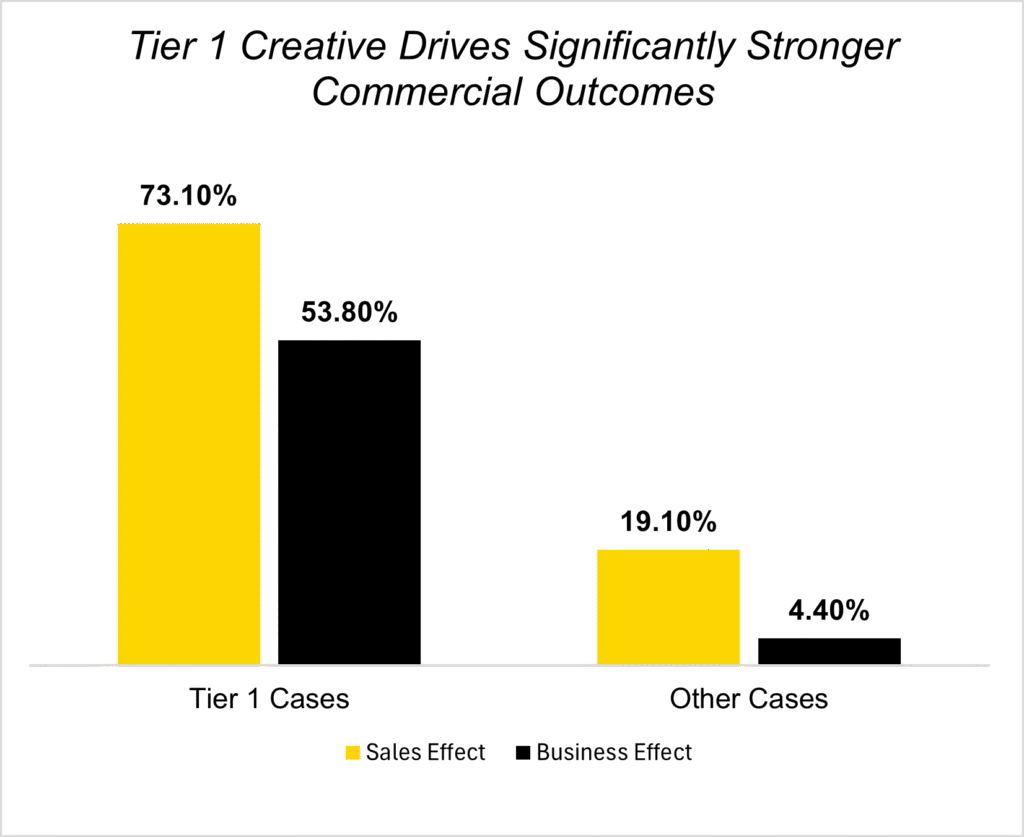
Source: Rory Natkiel, The Sponsorship Effect, SEF, 2025
Data needs emotion to create value
A well-executed CRM journey built around a forgettable idea might show short-term gains in digital metrics. It might even produce a decent cost per acquisition. But it will not compound memory. It will not build brand effects that endure beyond the campaign window. It will not create pricing power.
This is where the current obsession with first-party data becomes problematic. Data is a tool. It is an enabler. It can help you refine targeting, personalise messaging, and track behaviour. But it cannot create an emotional response. It cannot generate cultural talkability. It cannot transform a transactional partnership into a fame-building platform.
System1’s work consistently shows that emotional creative outperforms rational creative on long-term business effects. The most profitable campaigns are those that build strong memory structures and positive feelings at scale. Sponsorship should be uniquely well-placed to do this. Sport is emotional. It is tribal. It is culturally salient.
Yet too much sponsorship activation is functional. It explains, promotes or informs. It rarely surprises or moves.
Structural forces prevent creativity
There are structural reasons why creativity often underdelivers in sponsorship. The sector is built around negotiating complex rights agreements, and so much effort goes into securing the deal that activation becomes secondary.
The activation brief then tries to satisfy multiple stakeholders and is often written through a commercial lens rather than a creative one. When the brief is compromised, the output follows. If you accept that creative quality is the real multiplier, the implications are significant:
1. Sponsorship evaluation needs to change
If the internal commercial case is built primarily on data capture and short-term lead generation, activation will optimise for those outcomes. That encourages safe, direct response-style executions. It does not encourage creative risk.
2. Rights-holders need to enable distinctive ideas, not just sell inventory
Inventory and access are table stakes. The differentiator is whether the property can act as a springboard for distinctive brand platforms.
3. Sponsors must treat activation as seriously as the rights fee
Too often, most intellectual energy goes into negotiating the deal, while activation budgets are squeezed or left vague. The deal is not the asset. The idea is.
The implications for measurement
When activation creativity is weak, data becomes a crutch. We measure what is easy to measure: clicks, leads, downloads, and installs. But many of the most important sponsorship effects are indirect and long-term: mental availability, consideration, brand preference and willingness to pay.
Those effects are driven by memory and emotion. And memory and emotion are driven by creative quality.
Data still matters. First-party data can deepen relationships and optimise strong platforms. But it cannot rescue a poor concept.
If your activation is generic, segmentation will not make it distinctive. If your content is interchangeable, CRM will not make it memorable. If the idea could be lifted onto another property with minimal change, you do not have an idea; you have an execution.
In terms of effectiveness, creativity determines the ceiling. Data determines how efficiently you approach it.
You can build the infrastructure and refine attribution. But if the idea is forgettable, the outcome will be too.
About the author
Rory Natkiel helps brands and rights-holders improve the effectiveness of sponsorship and partnerships. After two decades in brand and communications strategy, he is now Co-Founder of the Sponsorship Effectiveness Forum, helping organisations raise standards around sponsorship creativity