
Chaucer Group and Surrey CCC: Why B2B brands are turning to sponsorship

B2B brands have long been present in sponsorship, but their role in the market is becoming more prominent.
From professional services firms to industrial companies, B2B organisations are increasingly using partnerships with sports teams and venues to build reputation, strengthen relationships and signal market stature.
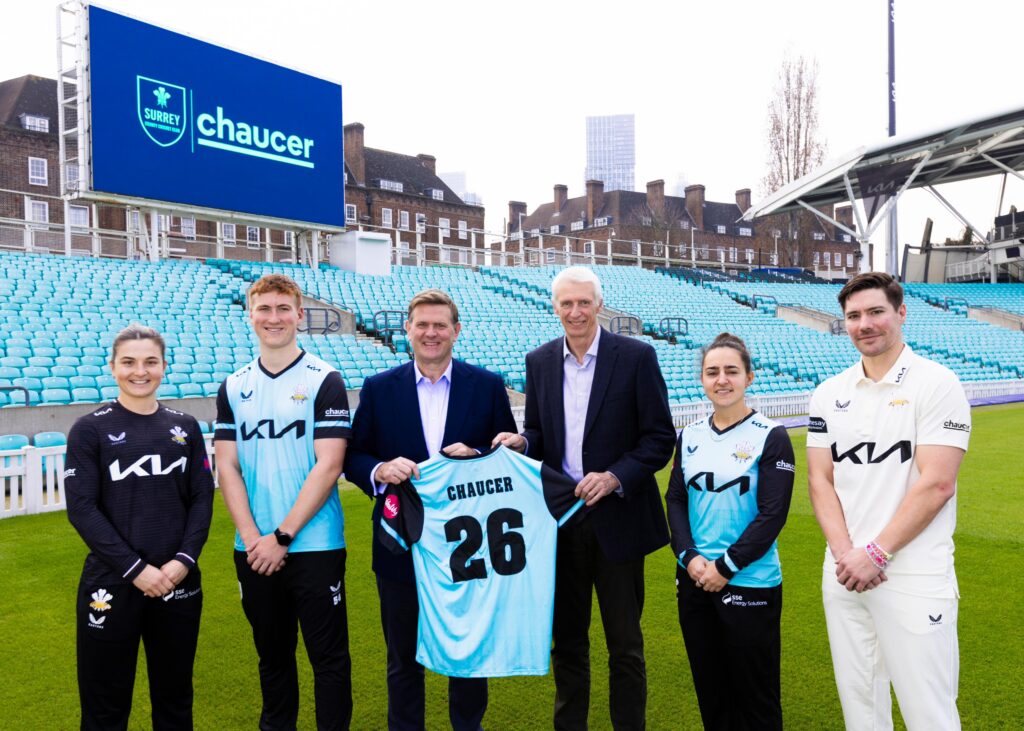
The latest comes from the insurance sector, where Chaucer Group has agreed a three-year partnership with Surrey County Cricket Club.
From the 2026 season, the (re)insurance company will become sleeve partner of both Surrey’s men’s and women’s teams, alongside prominent branding at the Kia Oval and access to corporate hospitality at one of international cricket’s busiest venues.
To understand the thinking behind the deal, The Sponsor spoke to Jamie Newton, Head of Marketing at Chaucer Group. The partnership provides a useful case study in how B2B brands are approaching sponsorship today and why the channel is becoming an increasingly important part of their marketing mix.
Signalling scale and market stature
One of the most common motivations behind B2B sponsorship is not simply awareness, but perception.
Unlike consumer brands, many professional services and financial firms operate successfully for years without investing heavily in public marketing. As they grow, however, that quiet approach can create a gap between the scale of the business and how it is perceived externally.
Newton says that was a factor in Chaucer’s decision. “We’re a brand that has been very subtle in how we’ve broadcast ourselves in the past,” he explains.
As a privately owned company, Chaucer’s scale is not always widely understood despite strong growth in recent years.
“I think we’ve sometimes been perceived as smaller than we actually are,” Newton says.
Sponsorship provides a way to change that perception.
“When you start deploying across channels like sponsorship, you’re conveying a message,” he says. “You’re showing that we’re a large brand that should be respected.”
For B2B marketers, this signalling effect is often a key driver. Appearing alongside major sporting properties can communicate confidence, credibility and market stature in a way that traditional marketing rarely achieves.
Access to the right audience
While consumer brands often pursue sponsorship for scale and reach, B2B sponsors typically prioritise the environment around the property.
Cricket has long been attractive to businesses targeting senior decision-makers, combining strong corporate hospitality with a highly affluent audience profile.
For Chaucer, that made Surrey a natural fit.
“A big part of it for us was getting closer to our core audience,” Newton says.
The Kia Oval hosts a packed schedule of domestic and international fixtures, offering regular opportunities to host brokers, partners and clients.
That calendar will also include one of the sport’s biggest events when England hosts Australia in the 2027 Ashes series.
“We want to make sure that if people want to celebrate those moments, they can celebrate them with Chaucer,” Newton says.
Sponsorship’s impact on talent attraction
For many B2B companies, the value of sponsorship increasingly extends beyond commercial relationships.
Newton believes the partnership can also play a role in raising awareness of Chaucer as an employer.
“Insurance is often overlooked when people think about careers,” he says. “But there are huge opportunities in the industry.”
Greater visibility through sport can help introduce the brand to audiences who may not otherwise encounter it.
For companies competing for specialist talent, this employer-brand dimension is becoming an increasingly important part of the B2B sponsorship equation.
A tool for internal culture
The Surrey partnership is also intended to work internally.
Chaucer employs around 750 people globally, with roughly 550 based in the UK, and Newton sees the sponsorship as a way to create shared experiences across the organisation.
“Our people are our brand,” he says. “We want to make sure we nurture that culture internally.”
Whether through match attendance, watch-along events or simply the shared excitement of major sporting moments, sport can provide a focal point that helps bring employees together.
Aligning partnerships with values
Another feature of the agreement is Chaucer’s decision to sponsor both Surrey’s men’s and women’s teams.
For Newton, that reflected a broader commitment within the company to improving representation within the insurance industry.
“Diversity is key for us,” he says.
Financial services have historically struggled with gender balance at senior levels, and Newton says Chaucer is working to help change that.
A broader shift in sponsorship
Chaucer’s move into sponsorship is a first for the company, but the motivations behind it are becoming increasingly familiar.
Competition is intense across many B2B sectors, and companies are placing greater emphasis on brand visibility, reputation and talent attraction alongside traditional relationship marketing.
Sponsorship offers a platform that can address all three.
For Chaucer, the Surrey partnership combines several objectives: signalling the company’s scale, strengthening relationships with brokers and clients, supporting employer brand and creating a focal point for employees.
For the sponsorship industry more broadly, the deal reinforces a wider trend.
Consumer brands may still dominate most sponsorship categories, but B2B firms are becoming an increasingly important part of the market.