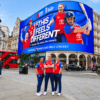
Cultural moments to commercial outcomes: The strategy behind BT’s EURO 2028 sponsorship

The media landscape is fragmented. Audiences are dispersed across streaming platforms, social media channels, creators, and second screens, making it harder than ever for brands to participate in moments that genuinely unite the public at scale. For BT, that is precisely what made UEFA EURO 2028 impossible to ignore.
The telecommunications giant, which recently refreshed its BT consumer brand and relaunched BT Mobile, saw the tournament not simply as a sponsorship opportunity but as a rare cultural moment capable of bringing the UK together in a way few events still can.
Speaking exclusively to The Sponsor, Gary Bansor, Head of UEFA EURO 2028 Sponsorship at BT, claims the tournament represents a rare national sporting moment.
“We are looking at it akin to London 2012 and then a bit further back to UEFA Euro 96, where it will be this national moment of celebration,” Bansor explains. “We are proud that we are going to be behind that. We are going to be bringing brilliant things to life for our customers and for the UK through the delivery of that tournament.”
EE, part of the BT Group, had recently renewed its Home Nations sponsorships and Wembley Stadium partnership through to 2028, making EURO 2028 a natural extension of an already established football strategy.
“Football works really well for the brand,” says Bansor. “We know we have a really clear roadmap to get us to EURO 2028 through the current properties that we have.”
That existing sponsorship ecosystem also reduced execution risk. Rather than building a sponsorship strategy from scratch, BT can develop and test products, fan experiences, and operational capabilities years in advance of the tournament itself.
“Whilst UEFA EURO 2028 is obviously a massive tournament, all of the programmes that we are delivering we either already do now and are ramping up, or we will be able to implement before the tournament through the Home Nations sponsorships and our Wembley connectivity,” Bansor explains. “If you come at one of these tournaments cold, you have basically two months to get it right; that’s not the case for us.”
Connectivity as a functional role
BT will provide broadcast connectivity infrastructure, training base connectivity, and wider ICT services across the tournament, giving the company an operational role within EURO 2028 beyond traditional sponsorship visibility.
“We are delivering a whole number of core connectivity requirements for UEFA, from the broadcast connectivity through to connecting all of the training bases,” says Bansor. “That allows us to position ourselves as supporting the tournament and connecting the tournament.”
For BT, the real opportunity sits in how that connectivity can improve the wider fan experience around the competition itself, particularly within fan zones and public viewing environments.
“It is the moments around the tournament that I am most excited about,” says Bansor. “Particularly the fan zones and what we can do from a connectivity point of view to improve the experience for supporters.”
One of the ways BT is exploring that is through an official tournament eSIM product, allowing travelling supporters and non-BT customers to access its mobile network throughout EURO 2028.
“A huge number of fans will be travelling to the UK, and a huge number of our competitors’ customers will be experiencing UEFA EURO 2028,” Bansor explains. “We really want them to be able to tap into our connectivity through the tournament.”
The objective is not simply visibility, but relevance. Rather than attaching itself to the tournament externally, BT’s ambition is to use connectivity to become part of how fans experience EURO 2028 itself.
Turning sponsorship assets into experiences
BT is also exploring ways to layer connectivity into more traditional sponsorship assets. One example is the tournament flag-bearer mascot programme, where bodycam footage from child flag bearers will be streamed live to parents inside the stadium before later being repurposed into social and digital content.
“These first-hand video case studies and social content showcase our connectivity helping to deliver incredible money-can’t-buy experiences.”
“A mascot is not a new sponsorship asset,” he adds. “But the connectivity element is.”
Shared attention in a fragmented media landscape
The partnership also reflects BT’s belief that major international football tournaments remain one of the few media environments still capable of generating mass simultaneous attention.
Whilst sports consumption has become increasingly fragmented across broadcasters, digital platforms, creators, and social feeds, Bansor believes international football still operates differently.
“The sports media landscape is very fragmented,” he says. “But uniquely, international football is the big moment where that landscape goes back to a more traditional model.”
He points to the continued scale of live audiences around major England matches as evidence.
“If England go deep into a tournament, tens of millions of people will come together to watch it on a linear broadcast,” Bansor explains. “I do not think there is much in media that really gives you that anymore.”
That rare concentration of public attention is central to BT’s wider activation strategy, which will combine traditional advertising with social, digital, and live content production across the tournament.
From cultural moment to commercial outcome
Despite the scale and cultural significance of EURO 2028, BT’s investment still needed to satisfy the same commercial scrutiny applied to every other major marketing activity within the business.
Crucially, the company did not create a sponsorship-specific measurement model to justify the partnership. Instead, sponsorship is assessed through the same econometric framework used across BT’s wider advertising and marketing investment.
“We have an econometric modelling approach which looks at the uplift in both master brand consideration and specific product consideration as a result of people being aware of our sponsorships,” Bansor explains.
The framework evaluates how sponsorship awareness influences consideration for BT’s core products and services, including broadband and mobile, before modelling the likely commercial impact over time.
“We have been doing this for over 10 or 15 years now,” he says. “We know that when people become aware of our sponsorship, they are more likely by a certain percentage point to consider us in that purchase funnel and we can put a value on that.”
“We have not created a sponsorship-specific model,” says Bansor. “We have plugged sponsorship into the same model that is used internally across all of our above-the-line marketing.”
That allowed BT to assess EURO 2028 not simply as a cultural opportunity, but as a commercially accountable investment capable of delivering measurable brand and business impact.
Join the debate
Bansor’s colleague Luke Souchard, Head of Sponsorship at BT, EE and Plusnet, will be speaking at Sponsorship Masters on 11th June alongside Sally Moore, Global Sponsorship Lead at Sage and digital media expert Jo Redfern to discuss shifting media consumption behaviour of different audience groups and how sponsors can best engage them. Register here for the final places.